


The Cleveland Museum of Art will likely attract big crowds this spring with blue chip shows on the artistic romance of French Impressionists Edouard Manet and Berthe Morisot and a career survey of the major American sculptor Martin Puryear.
But if you want to get acquainted with a brilliant but long overlooked American artist who deserves renewed attention, head to Oberlin.
Through May 24, the Allen Memorial Art Museum at Oberlin College is exhibiting an astounding and fresh retrospective on the late June Leaf, a figurative artist who reveled in exploring the human comedy, with special attention to women and their bodies.
Like all shows at the Allen, it’s free.
For decades, Leaf, who died in 2024 at age 94, has been less widely known than her longtime third husband, the Swiss-American photographer and documentary film maker Robert Frank (1924-2019). Frank earned iconic status in 1958 with the publication of his book, “The Americans,’’ a masterpiece of documentary photography that exposed racism and inequality beneath the country’s glossy postwar surface.

The Allen show, with more than 100 works by Leaf spanning 75 years, attempts to give her an overdue measure of art historical justice. That’s true in the feminist sense of bringing her out of her famous husband’s shadow. But the show also highlights how critics and art historians can have a hard time categorizing someone as original and unconventional as Leaf.
“I'm trained as an art historian. We put people in boxes,’’ Sam Adams, the show’s co-curator and the Allen’s curator of modern and contemporary art, said as if revealing a trade secret in an interview at the museum.
Leaf never fit in any boxes neatly. Today that looks like a strength, not a liability.
Radical misfit
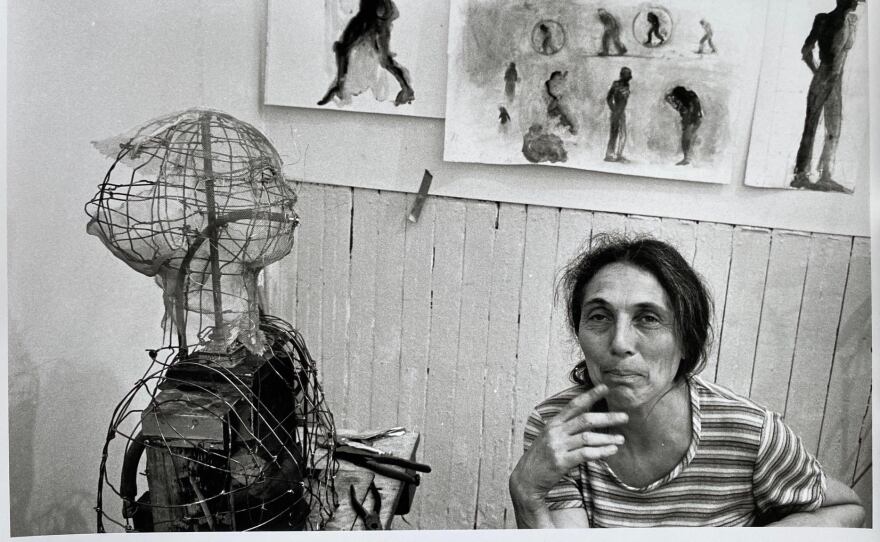
Born in Chicago in 1929, Leaf was the daughter of a second-generation Jewish immigrant couple of Eastern European heritage. Her parents owned a liquor store and bar in a working-class neighborhood redolent of the hard-knock exuberance of Saul Bellow’s 1953 novel, “The Adventures of Augie March,’’ a fictional autobiography of a young man growing up in Depression-era Chicago.
Leaf grew up viewing “scenes of bacchanalian revelry and overindulgence’’ in her parents’ tavern, the show’s two other co-curators, Allison Kemmerer and Gordon Wilkins, said in the show’s catalog. Both work at Addison Gallery of American Art Phillips Academy in Andover, Massachusetts, where the exhibition debuted last year before heading to the Grey Art Museum at New York University.
Leaf, as Kemmerer and Wilkins say, remembered her parents’ business as a “claustrophobic and overwhelming stage set comprised of urine-and-vomit-soaked, sawdust-covered floorboards, and tables covered in long sheets of brown paper,’’ imagery that could have come out of Augie March.
Leaf’s mother tried to mold her into “a nice Jewish girl,’’ and insisted she attend the University of Illinois Urbana-Champaign, where she could, as Leaf later said, “sell for lots of money to a nice Jewish guy.’’
Transferring to a string of art schools in Chicago, Leaf earned a bachelor’s degree in art education at Roosevelt University in 1954 and a master’s degree in the same field the same year from the Institute of Design at the Illinois Institute of Technology.
Leaf also found affinity at the time with Chicago artists including Leon Golub, a painter of vast figurative compositions saturated with political outrage, and feminist artist Nancy Spero, to whose work Leaf’s can be compared. Both were part of Chicago’s Monster Roster, a group that defied the prevailing mid-century Abstract Expressionist style by embracing raucous, edgy and surreal figurative imagery.

Against the grain
After marrying jazz musician Joel Press in 1960, Leaf established herself on New York’s Lower East Side, where she continued to champion her rowdy brand of narrative figurative art, even as Pop Art, Minimalism and Conceptual Art came into vogue.
Early works in the show include “Arcade Women,’’ 1956, a colorful but dystopian vision of women imprisoned in a grid-like matrix — perhaps an early sign of Leaf’s readiness to break out of constraining structures.
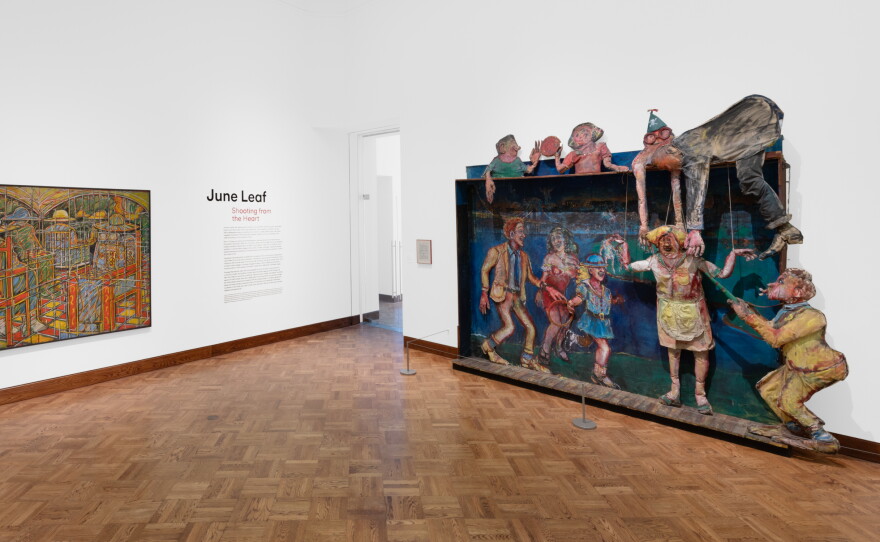
Within a decade, Leaf was portraying carnivals and street scenes that skewered power and hypocrisy with countercultural glee.
In 1966, she parodied a 17th-century interior scene by Johannes Vermeer, revealing the sexual intrigue and potential violence she saw beneath the Old Master’s placid surfaces.
She followed up in 1968 with “Ascension of Pig Lady,’’ 1968, a wall-size painting and fabric sculpture inspired by a waitress at a Second Avenue restaurant who became a religious fanatic. Leaf shows the titular character rising to heaven on marionette strings, supposedly as she morphs into a pig.
Action, plus drawing
In style, Leaf’s painting in the 1960s and ‘70s had lots of expressionist action, with accidental drips and a lively but deliciously sure sense of touch rooted on her command of drawing the human figure.
Her painting and drawing both took on a confident, unfussy deftness that could be compared to the work of Pop realist Jim Dine but wouldn’t be confused with his. Other sources for Leaf included the paintings and etchings of the 19th-century painter Francisco Goya and the social satires of the Belgian post-impressionist James Ensor, who pilloried his country’s early 20th-century imperialism.
It was quite a cocktail, and it confused critics who felt compelled to write about Leaf’s early breakout shows, but who couldn’t figure out exactly where to place her.
Kemmerer and Wilkins cite a withering 1973 "New York Times" review by John Canaday, in which he sniffed that “Miss Leaf is an exception to everything, including every specific esthetic standard ever formulated, and I am going to throw her out pending a session with Roget’s International Thesaurus to see whether there is a synonym for 'repellent' that means “'attractive.'”


In fairness, Adams said, viewers of the Oberlin show have the advantage of seeing Leaf’s entire development, not just the early works from the 1950s to the early 70s after which she abandoned New York.
Moving to Nova Scotia
After divorcing Press, Leaf, a self-proclaimed “city girl’’ relocated to the small coastal village of Mabou in Nova Scotia with Frank, whom she married in 1975. (Frank was her third husband according to the show’s catalog. Little is known about her first husband, Adams said.)
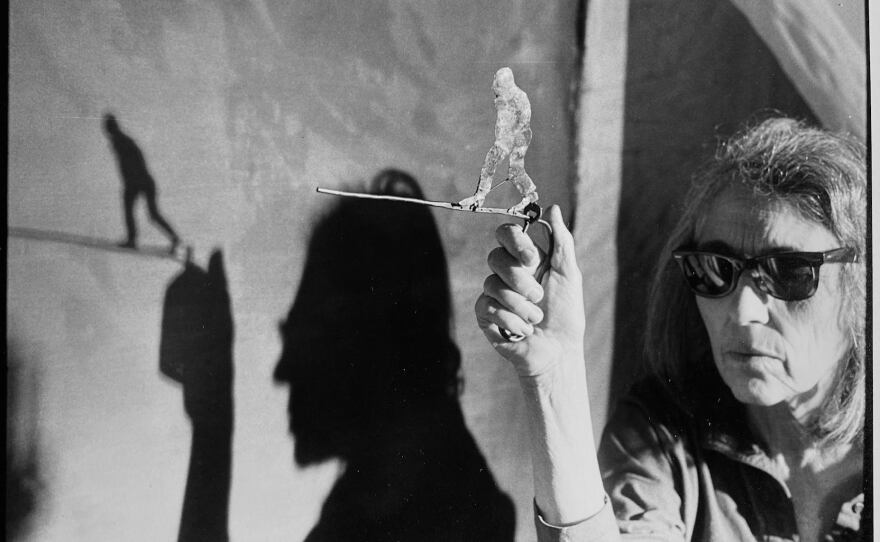
It was in Mabou, overlooking the Gulf of St. Lawrence, that Leaf raised sculpture and assemblage to new prominence in her work.
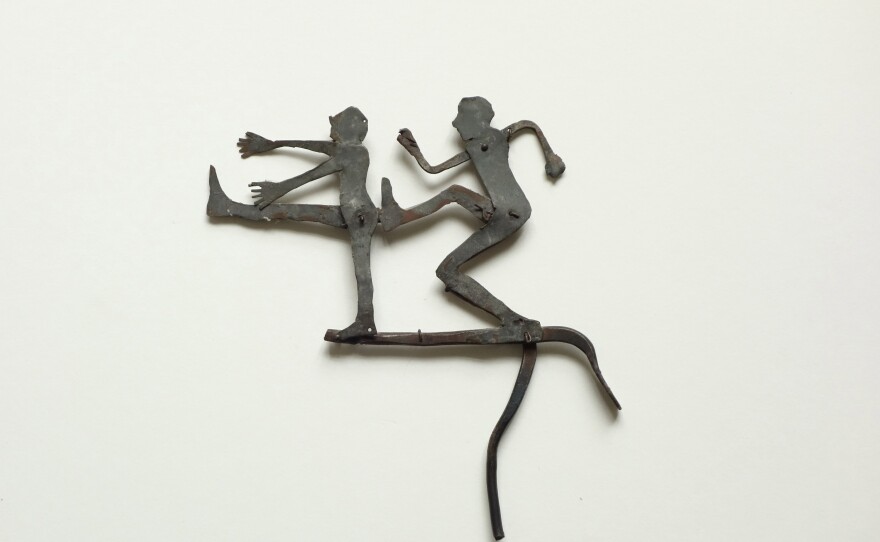
She fashioned constructions in wire and cutout sheets of metal that channeled the spirit of Alexander Calder’s “Circus” into earthy meditations on intimate human relationships.

At times, her sculptural tableaux bring to mind the isolated, emaciated figures of Alberto Giacometti. She portrayed female body in drawings as a collection of balloon-like spheres, bringing to mind the eroticized surrealism of Louise Bourgeois.
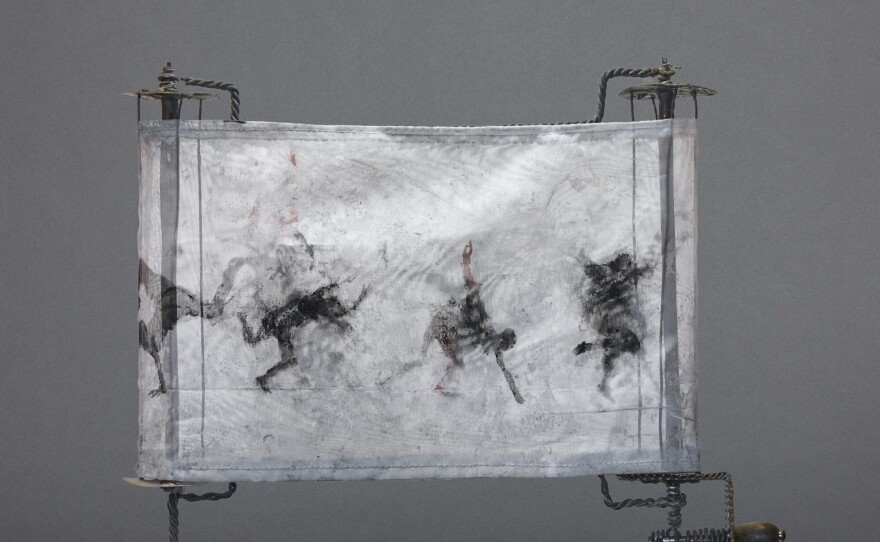
Several works in the show resemble Torah scrolls inscribed with ghostlike images of dancing figures that can be advanced with a crank.
Leaf loved dance and mime and had an uncanny ability to express emotions through choreographic poses, as if her figures were on stage, or ascending spiral pathways to heaven.
In one work that blends painting and sculpture, she flips the Pygmalion script by portraying a kneeling woman in the act of drawing a man on a curved sheet of metal in a way that could bring him to life by adding a final touch to his penis.
The artist speaks for herself
Rather than fill the exhibition with descriptive labels, the show often lets Leaf speak for herself, using quotations from various interviews.
One example states that Leaf said she saw her job as that of being “a great archer. All the other stuff I have no control over. In a way, I’m not even interested in what the arrow is going to do and what the arrow wants to say.’’


The show hints that Leaf’s decision to stay in Nova Scotia with Frank may have reduced her visibility, not that she seemed to care. A video in the exhibition, made by Leaf’s friend and neighbor, the pioneering video artist Joan Jonas, suggests that Leaf was happiest when working, and hated interruptions.
It might be hard, even now, to find the right art historical box to put Leaf in because her work connects to those of so many artists from whom she took inspiration. That quality has led some observers to call Leaf an artist’s artist.
But even without knowing about all the references embedded in her work — and how Leaf created an original and distinctly identifiable visual language out of them — it’s easy to grasp the joy, energy and wit that come across throughout the show. That’s what matters most, and it’s why the exhibition absolutely deserves to be seen.
