


Nearly every chair is filled at a Hamilton City Council meeting in mid-November. Longtime resident Teri Cunningham sits in the front row, shifting a stack of papers around in her lap. She says she hates public speaking. But she's here to make a point.
“Question: Have you considered the fact that we may not want more data centers?” Cunningham asked the Council.
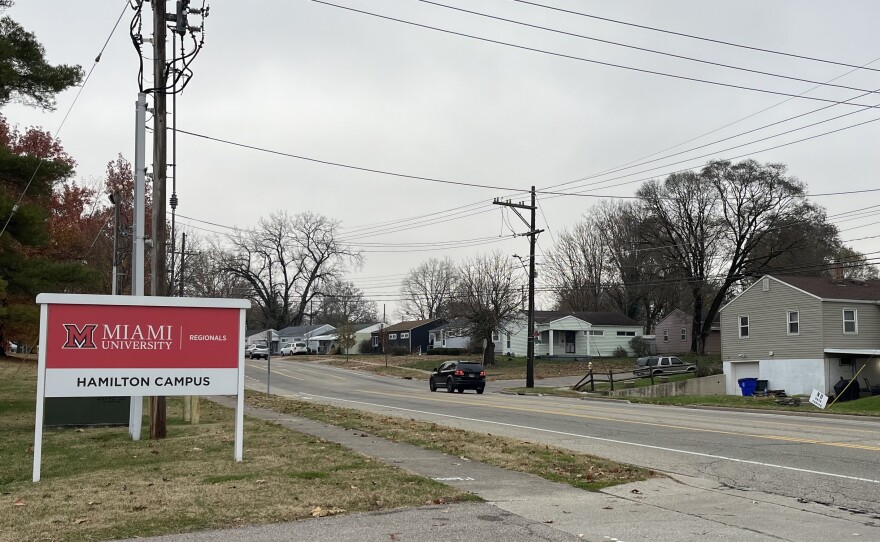
She's talking about a proposed data center on 29 acres of wooded, city-owned land, near Miami University's Hamilton campus and about 50 homes. Plans for another data center are underway up the road in Trenton.
AI use is ballooning, and new data centers are popping up throughout the country to support growing demands for computing power.
While the two Butler County projects have support from some government leaders, some residents say they’re worried about environmental consequences and energy use. And, they’re pushing back.
What are data centers?
These facilities store computer systems.
“One way to think about a single data center is that it is a big warehouse with a huge HVAC system and chips,” said Yury Dvorkin, an engineering professor at Johns Hopkins University in Baltimore.
He says data centers consume a lot of resources.
“They don't run on air,” Dvorkin said. “They consume a lot of electricity, primarily for cooling purposes, to make sure that the chips that are used for training AI are being operated within a reasonable temperature range.”
The data center proposed in Hamilton could need up to 240 megawatts of electricity at any given moment. Dvorkin says that's equivalent to the energy consumption of about 24,000 households.

What’s happening with the project now?
The developer, Logistix, has received some approvals for the project from the city.
City Manager Craig Bucheit says he's interested in the data center's potential economic benefits, like up to 100 new full-time jobs. But he says the city still has much to consider.
“We have to be open-minded, and we have to be looking for opportunities. So, we do owe it to open the door and have a conversation and see if there's a path forward,” Bucheit said. “Maybe there is. Maybe there's not.”
The city is waiting on two studies to determine how much power Hamilton could supply the project, if the city could generate more, and what infrastructure upgrades would be needed to deliver that higher load.
The energy use question
Data centers' enormous demand for electricity is part of the reason why people in states like Ohio are seeing their bills get more expensive. And, it's a major reason why people oppose these developments coming to town.
Jay Kidd lives in Hamilton and owns a small business.
“There are several concerns that I have — and a bunch of us have — about it. First and foremost, and this is this may sound a little bit selfish, but there's the utility cost involved,” Kidd said.

Bucheit says Hamilton residents would be shielded from any price increases. The city owns and operates its electric utility and generates most of the power it needs.
“It'll have very little or no impact on their utility bill, because it's not going to come from the power that we currently generate,” Bucheit said. “The power for this project would be sourced by us on the open market, and then we’d pass that power through to the developer at cost. So, the cost associated with sourcing that power and bringing it here would be passed on 100% to the developer.”
Bucheit says the developer is paying its own way, including for facilities and infrastructure related to the project.
A coalition forms to fight back
Some Hamilton residents aren't buying it. People like Teri Cunningham are worried the city could be opening its doors to more data center developers.
“I've studied a lot of other communities and the nightmare that the data centers are entailing,” Cunningham said.
People living next to data centers in Virginia report the noise makes it hard for them to spend time outside and bright lights keep them up at night. High water use by a data center in Georgia has tanked water pressure for some residents.
Cunningham wants to prevent that from happening in Hamilton.
She and others created a Facebook group called the Coalition Against Data Centers in South Ohio. It has more than 600 members. They’re circulating a petition, creating yard signs and speaking out at biweekly city council meetings, even when the data center isn’t on the agenda.
“It's a big monster to try to fight,” Cunningham said. “Every day I say, ‘Well, I'm going to give up.’ And then the next day I'm back on it again. I can't stop fighting this because it's so horrendous.”

They're worried about water use, noise and pollution.
The coalition wants the city to scrap the project. They say they'll be at every city council meeting until that happens.
Read more: