

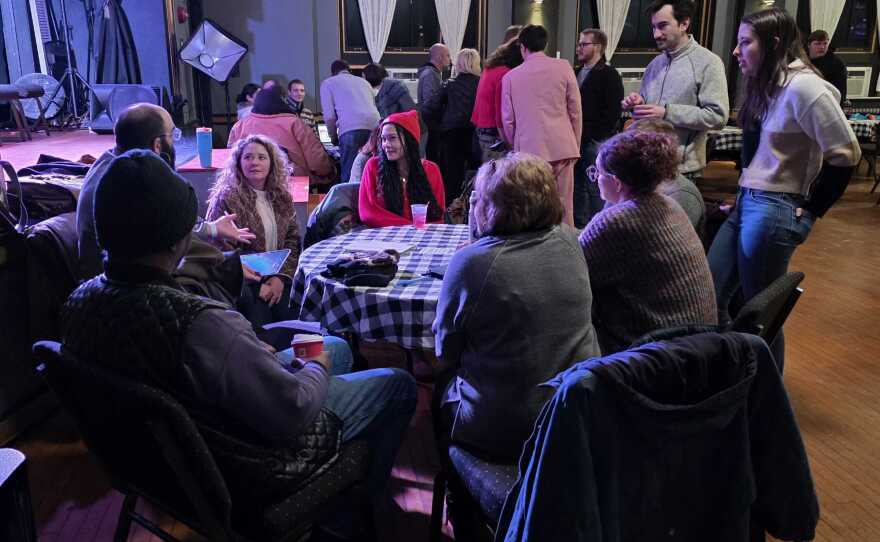

Hamilton County has transitioned from politically red, to purple, to solidly blue. Some local Democrats say during Trump's second presidency and with a Republican supermajority at the Ohio Statehouse, just getting Democrats elected isn't enough.
A group called the Cincy Precinct Project wants to pressure the local Democratic party to move further left. Jack Cunningham launched the project last summer.
"I believe that our leaders in the Democratic Party and its apparatus ought to be doing more. I believe they care — I do not believe they care enough," Cunningham told WVXU. "And I and so many others are [so] worried about our future that I am compelled to not only bring attention to how the Democratic Party operates, I want to further democratize it and bring attention to how everyday people can get involved in the party."
He's not alone. The Cincy Precinct Project recruited about 150 people to run for the position of precinct executive in the May primary, aiming to win enough positions to influence decisions on party leadership and candidate endorsements.
What is a precinct executive?
A precinct is a geographic area with no more than 1,400 voters, and each political party can elect one executive who lives in that precinct. These executives make up the party's Central Committee, which elects the party's leadership.
Precinct executives within the city of Cincinnati vote on endorsements for city elections (Council and the mayor). County-wide, precinct executives help decide who sits on a smaller executive committee that chooses which candidates to endorse each election cycle.
Hamilton County has 563 precincts, but about half typically don't have an executive for any party. This year, about 70% of precincts have at least one Democratic candidate on the May ballot. Most of them are uncontested, but about a third have two or more candidates.
Cunningham says the Cincy Precinct Project has recruited enough people to make a real difference in the Hamilton County Democratic Party.
"We have already pushed the Democratic Party's attention onto our effort, and we are now in a position where we have a lot of leverage to make decisions in the future," he said. "So, we hope that the party embraces us and the energy we've brought. And if they don't, that's OK. We have a network of people who are concerned and organized, talking to each other, and we aren't going anywhere."
A group of 'do something Democrats'
Much of that energy comes from opposition to what's happening at the state and federal level. The group's "major issues" are, in their words:
- "Protecting our community (LGBTQIA+ rights, women's health, immigrant rights, the dignity of the homeless, etc.) from an increasingly aggressive Ohio state government and federal government.
- "Creating a more democratically responsive and transparent municipal government through empowering neighborhood boards, precinct executives, inspector generals, and auditors.
- "Prioritization of more effective measures for public safety such as public schools, public housing, lead removal, healthcare debt abolition, and municipal infrastructure."
Debra Hackett is running her first ever political campaign to become a Democratic executive in her Norwood precinct.
"I'm disheartened to find out that what I thought the Democratic Party was about, they say on paper and are not," Hackett said. "They're not living it out — they're not doing it."
Hackett says she's overwhelmed by issues like Trump's actions in Venezuela, his threats to take over Greenland, immigration enforcement, and the killing of two U.S. citizens by federal agents in Minneapolis.
"This year has been a turning point, and instead of being afraid, overwhelmed and in despair, I thought, 'I've got to do something.' "
Hackett says being part of the Cincy Precinct Project is energizing. Participants call themselves "do something Democrats."
Cunningham says he's concerned about how the local party operates.
"We are tired of the corporate control over the Democratic Party, and we are tired of lobbyists making decisions and affecting the culture of the Democratic Party," he said. "We want to bring the Democratic Party back to the roots of helping working and everyday people."
Some Cincy Precinct Project advocates say the local party is not transparent in its endorsement process, and that a Democratic endorsement is contingent on giving and raising donations for the party.
Democratic leadership response
Alex Linser stepped into the unpaid position of Hamilton County Democratic Party Chair about a year ago. He says some of the criticism amounts to speculation and even conspiracy theories.
"My job is to win elections, and the people who win those elections, it's their job to make policy," Linser said. "I'm not a political boss, and I don't want to be a political boss. I don't want to tell them how to do their jobs."
Linser says he rejects the idea that the party endorsement is inaccessible to working candidates.
"Our [candidate] questionnaires all say specifically that our endorsement is not contingent upon a past history of giving," he said. "We do ask candidates about their fundraising plan, about their fundraising history, because we do want to see candidates that are viable and ready to run a successful campaign. But it is absolutely not true that our endorsements are contingent upon somebody giving money to the party."
He points to the slate endorsed for the most recent Cincinnati City Council election in 2025 — with eight incumbents running for re-election, one more endorsement slot was open, and two candidates interviewed for it: Raffel Prophett and Ryan James.
"Prophett was an excellent fundraiser. At the time he interviewed, he had already close to $50,000 raised for his campaign," Linser said. "And if the party was solely focused on that, he probably would have been our candidate, and he was a very strong candidate. But the party instead endorsed Ryan James, who's a very young candidate without much history of fundraising."
Linser also touts the party's policy to open endorsement meetings to the public.
Overall, Linser says he welcomes more precinct executives to the process.
"If people want to see the candidates that we endorse move a certain way, well, we decide that together," Linser said. "The people we pick are a reflection of what that body wants to do. If people have different ideas about that, that's what the body is for."
Linser says the party's top priority right now is the midterms in November.
"We absolutely have to elect a Congress that will be able to rein in the Trump administration," he said. "But after that, there's going to be a two-year period where the Democratic Party is going to have to have a big national conversation about, what is our platform and what is our vision for this country?"
The Cincy Precinct Project also is planning for the long-term. Cunningham says they aren't going anywhere.
"We are not strangers. We are not radicals. We are not here to burn the system down," he said. "We are people here who are taking what we have in the most peaceful, transformative way to build up political power for working and everyday people."
What happens next
About 40 people affiliated with the Cincy Precinct Project are running unopposed in the May primary, guaranteeing them a spot on the Democratic Central Committee. Another hundred or so contested races have a Cincy Precinct Project candidate.
The election results will be the first indication of whether it's enough to redirect the party's priorities. If all Cincy Precinct Project candidates win, they'll hold about a third of all occupied precincts, but the majority that matters is who shows up to a given meeting to speak up and cast a vote.
The position will appear on the primary ballot as "Member of Democratic Central Committee" or "Member of Republican Central Committee."
The Hamilton County Republican Party did not respond to requests for an interview.
The primary election is May 5. The deadline to register to vote is April 6.
Read more:
