


What might it be like to watch an alien spacecraft fall from the sky? Residents of Ava, Ohio, in 1925 experienced something close to this, when the USS Shenandoah, a naval airship, crashed down on rural farmland. Dean Regas chats with Ohio News Room journalist, Kendall Crawford, after her visit to Ava's mobile museum.
We want to hear from you!
Send us your thoughts on this episode at lookingup@wvxu.org or post them on social media using #lookinguppodcast
Episode Transcript:
Looking Up is transcribed using a combination of AI speech recognition and human editors. It may contain errors. Please check the corresponding audio before quoting in print. This transcript may include additional material from the conversation, not featured in the audio.
Dean Regas: These days, we see all kinds of stuff flying around the sky, planes, drones, satellites. But one thing we don't see quite as often anymore are balloons, zeppelins and airships. I mean, they used to be everywhere. So, if these things were so popular, why don't we see as many balloons in the sky today?
From the studios of Cincinnati Public Radio, I'm your host, Dean Regas, and this is Looking Up the show that takes you deep into the cosmos or just to the telescope in your backyard to learn more about what makes this amazing universe of ours so great. My guest today is Ohio Newsroom journalist Kendall Crawford, with a story of an airship crash that defined a rural Midwestern town.
But first, let's go back a bit. Paris, France, 1783. The Montgolfier brothers, Joseph-Michel and Jacques-Étienne they designed the first balloon to carry passengers aloft. And by the way, they were not the passengers. But soon bigger and better balloons followed, as aeronauts tried to outdo each other in distance, height and sheer brazenness. This was daredevil kind of stuff, and the crowds went wild for these flights. But aeronauts in the late 1700s and early 1800s didn't tend to fly for very long.
It wasn't too long after this that the first air disaster happened. This was in Ireland in 1785, when a balloon caught fire, crashed and destroyed about 100 homes.
Sophie Blanchard, who I'd like to dedicate an entire episode to in the future, she ascended in her first balloon in 1804 with her husband. This was Jean-Pierre Blanchard, an accomplished aeronaut and daredevil breaking all sorts of distance and height records. He had a heart attack while in a tethered balloon next to his wife, and he fell out of the balloon and died. But after Jean-Pierre's death, Sophie continued to do aerial demos solo. She died when her hydrogen-filled balloon caught fire and crashed into a Parisian neighborhood.
More than 100 years after that, a much different kind of balloon, an airship crashed in the fields of Ohio.
Kendall Crawford: Hi, my name is Kendall Crawford and I'm a reporter for the Ohio Newsroom, and I have put myself on the blimp beat recently.
Dean Regas: Well, Kendall, thanks so much for joining me today.
Kendall Crawford: Yeah, thank you so much for having me.
Dean Regas: You get to report on stories all across Ohio, but what happened more than 100 years ago on Sept. 3, 1925, that brought you to the town of Ava, Ohio?
Kendall Crawford: Yes. So Noble County, which holds Ava, Ohio, is a very rural area, and one of the goals of the Ohio Newsroom is to go to every county in the state. And so, for a while I'd been reading news in Noble County and on Sept. 3 like you mentioned I read a story about a hundredth anniversary of this airship crash, which I didn't expect in a headline at all.
["Lighter-Than-Air History Rigid Airship." United States Department of War, 1937]: The first American-built rigid was the ZR-1, or Shenandoah.
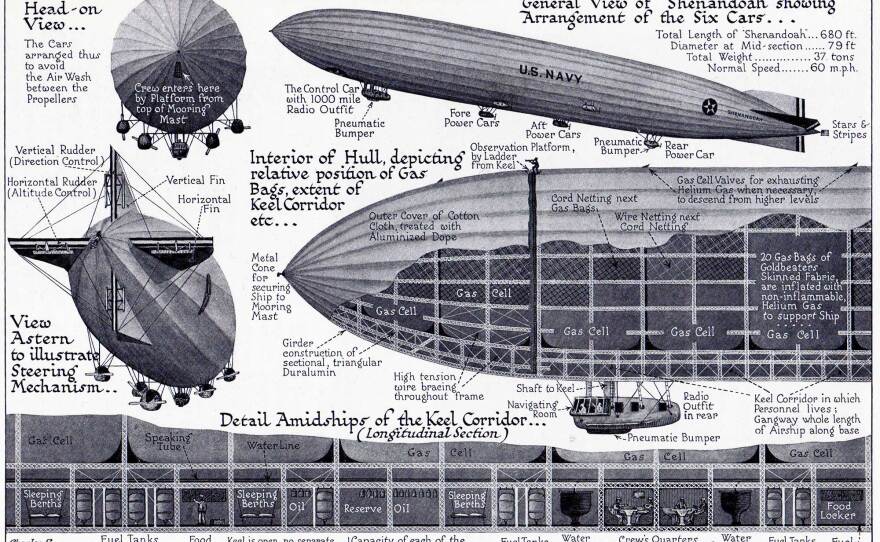
Kendall Crawford: I learned about the history of the USS Shenandoah, which was this 680-foot-long rigid airship —
["Lighter-Than-Air History Rigid Airship." United States Department of War, 1937]: The Shenandoah was a particularly important not because she was up to date, but because she was the first native-built, homegrown American rigid.
Kendall Crawford: which is kind of like what we call a blimp today. But instead of being all puffy, it's got like a steel frame around it and fabric covering it. And it was originally created for the purpose of being a U.S. Navy reconnaissance vessel.
["Lighter-Than-Air History Rigid Airship." United States Department of War, 1937]: The Shenandoah was the first rigid airship to moor to a floating mass, such as the U.S. Navy devised and installed on the tanker Patoka.
Kendall Crawford: So, its job would basically be to go out with the submarines and watch for enemies and anything dangerous and help the U.S. Navy in that mission. And at this time, it was also kind of seen as this really interesting innovation in aerospace. The U.S. Navy decides that they want buy-in for this program that they're working on for the airships, because the USS Shenandoah is one of the first ones, and so they send it out on a publicity tour, and it heads to the Midwest. And once it's enroute to Ohio, a big storm comes which was something that the captain was really worried about at the time. He had thought about postponing it and requested a postponing because he knew about summer squalls in the region.
["Lighter-Than-Air History Rigid Airship." United States Department of War, 1937]: The Shenandoah was lost in a line squall near Ava, Ohio, on Sept. 3, 1925.
Kendall Crawford: But unfortunately, they were still told to go out and do this trip. And in that storm, if you can imagine, something that's being lifted by helium isn't going to do well in this intense rain, this really, really rough wind.
["Lighter-Than-Air History Rigid Airship." United States Department of War, 1937]: 14 men, including Lt. Cmdr. Zachary Lansdowne, were killed.
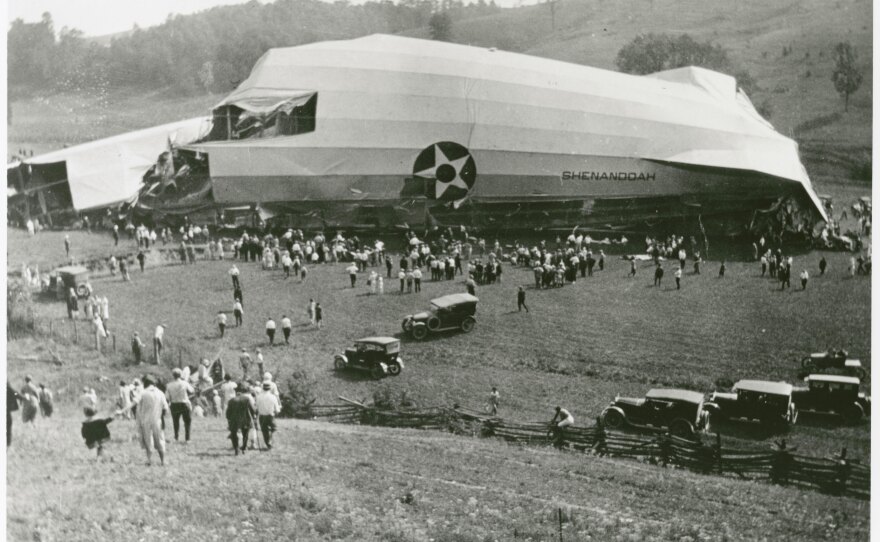
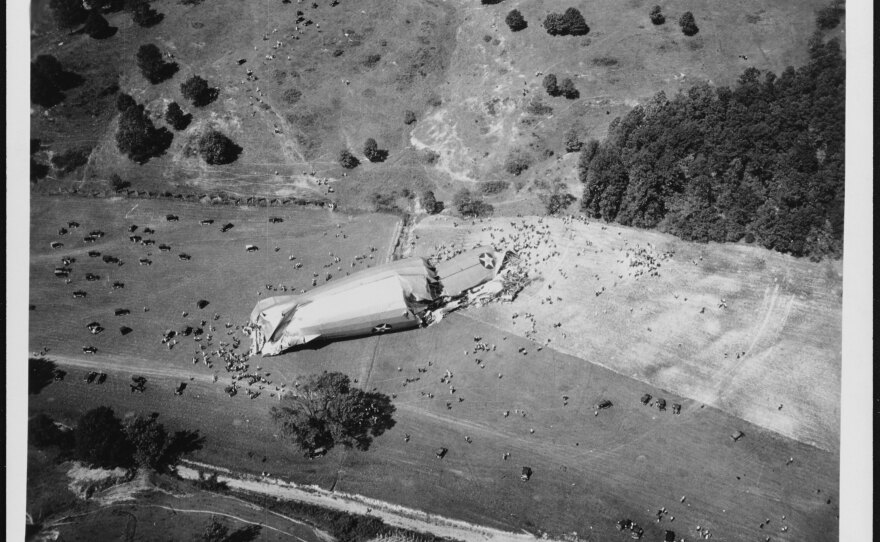
Kendall Crawford: And so unfortunately the Shenandoah falls and it crashes right in Ava, Ohio, in Noble County which is, like I said, southeast Ohio, very rural. A historian I talked to told me that it's probably very likely that a lot of the roads in Noble County hadn't seen automobiles yet. So those people had certainly maybe they'd seen an airplane if they were lucky, but they had never seen an airship like this.
Dean Regas: More Looking Up right after this.
["Sky Giants." Periscope Film LLC, ca. 1930s]: The big silver fish was over Ohio when she ran into a heavy storm. On the ground, farmers could hear her engines laboring in the gale high above. Rosendahl and his comrades fought to save their ship, but they failed. The Shenandoah had broken in half, carrying 14 men to death.
Dean Regas: Yeah, I mean, this is only 22 years after the Wright Brothers' flight, and this is a rural community. It probably was a very strange sight to wake up to. What was the reaction of the townspeople and the public when they saw this?
Kendall Crawford: Yeah, so it was a devastating and tragic wreck. Fourteen crew members of the 43 aboard died. So, the initial reaction was obviously to help these people, and I think people in Noble County were very generous. They were giving food from their garden; they were covering the people who had passed away and even in one instance were able to rescue some crew members. But also, they were just so fascinated about what this was and what was sitting in their backyard, in their farm fields all of a sudden, that it became kind of like a county fair in a way. Like everyone showed up to see the wreckage and to try to understand what had happened in this area. And so, a lot of people ended up, some would say, looting from the site before it was guarded and protected. As one person told me, it would be like a giant space shuttle coming down now and not being guarded at all. Like it's just so foreign to people that they really wanted a piece of it. These little scraps and pieces of metal and rope and even a water basin have actually become family heirlooms for people in Ava, and those stories were just kind of passed down from family member to family member.
Dean Regas: Well, and then you met Theresa Rayner, who has established a mobile museum to the tragedy, kind of collecting all these pieces together. Tell us about her, her motivation and maybe some of the items and stories you found in the museum itself.
Kendall Crawford: Yeah, she was such a wonderful person to meet. She was very positive. And the way she puts it is like she got married into caring about the USS Shenandoah.
[Theresa Rayner, Ava, Ohio, Mobile Museum]: Well, my husband, my late husband is the one that got us involved. His grandfather at one point in time owned crash site one and two, but not at the time of the crash.
Kendall Crawford: Her late husband, Brian Rayner, grew up on a farm that was actually the site of the crash. He would spend his childhood scavenging his backyard for pieces of the crash and was able to find quite a few things, and then he and his family began collecting hearing about other people's heirlooms and convincing them to add them to his collection.
[Theresa Rayner, Ava, Ohio, Mobile Museum]: And finally, I told him, I said, "You are going to wear this stuff out do something with it."
Kendall Crawford: And they would travel together in this really small, kind of beat-up trailer —
[Theresa Rayner, Ava, Ohio, Mobile Museum]: It was heavy, it was hard to tow around. It served its purpose, though.
Kendall Crawford: just showing people all the things that they had collected and teaching about the history of the USS Shenandoah at the same time. And since he's passed, she's continued it on, because it's just become such a big part of her life. And I think she doesn't want this forgotten which is interesting, because it's a sad story really. And people died that day.
[Theresa Rayner, Ava, Ohio, Mobile Museum]: So, these guys were pioneers. I mean, they were doing something new and experimental. And then I stop to think of the fact that it really happened right here in our backyard. I mean, it was a tragedy and lives were lost. But we've been told by pilots and other people involved in aviation that even though the lighter-than-air program through the Navy was not successful, there were things that were learned that have helped aviation down through the years.
Kendall Crawford: She wants them to be remembered for those contributions.
Dean Regas: So, being inside the mobile museum, what were some of the individual artifacts that kind of stood out to you?
Kendall Crawford: Yeah, so I think it's really interesting the stories behind the artifacts.
[Theresa Rayner, Ava, Ohio, Mobile Museum]: Probably one of the last big items that were found out at the crash site were these buttons.
Kendall Crawford: And when Theresa Rayner showed it to me, I was like, oh, it's a button but it was also like a naval uniform that someone actually found on the ship. And I also think a lot of the scraps of the wreckage that are there show the industriousness of the people in the community.
[Theresa Rayner, Ava, Ohio, Mobile Museum]: There's a piece of chain here. And there's the note that came with it.
Kendall Crawford: There was a piece of metal chain that she had on the wall, and I asked her about it. And she told me it's this part of the airship, but also it was used as a porch swing.
[Theresa Rayner, Ava, Ohio, Mobile Museum]: I guess some of the workers decided on their own they would just make some chains, and she said that was a piece that helped hold their porch swing up for years.
Kendall Crawford: There were also instances of the airtight fabric being used to fix lampshades.
[Theresa Rayner, Ava, Ohio, Mobile Museum]: Edna Nicholson, she lived in Cambridge, Ohio and she said when their family had been at the crash site, she said they picked up some fabric.
Kendall Crawford: In hard times, she had squirreled away this fabric that her family had passed down from the wreck, knowing that maybe you know maybe 100 years from now, it might be valuable.
[Theresa Rayner, Ava, Ohio, Mobile Museum]: The day came that she needed some of it. She ripped all the old stuff off the lampshades and replaced it with material that they'd found off of the Shenandoah.
Kendall Crawford: And there's also a legend she didn't have any instances of this, and there's no family that has come forward to say that this is 100% true but the rumor has it that after the wreck, a couple years later in Caldwell, which is the county seat of Noble County, they actually had a tailor there making raincoats out of the reflective material because it was waterproof, and they called them the Shenandoah slickers. But she was not able to locate any one of those raincoats.
Dean Regas: Oh man. Well, everybody out there that's listening if you have a Shenandoah slicker, contact us, please. Yeah, we'd love to see it.
Kendall Crawford: It would be really nice. I have a feeling that a lot of these are still in people's attics and basements, just waiting to be found you know, family boxes of memories.
["The Wreck of the Shenandoah," Vernon Dalhart]: [Song excerpt]
Dean Regas: Well, Kendall, thanks so much for joining me today and kind of shedding some light on this little-known aviation accident and a little bit more about the people that saw it. Thanks so much.
Kendall Crawford: Yeah, thank you.
Dean Regas: Boy, this sure did get me thinking about the alleged UFO crash in Roswell, New Mexico, in 1947.
["ABC News Roswell." ABC News Radio, 8 July 1947]: The Army Air Forces has announced that a flying disc has been found and is now in the possession of the Army. Army officers say the missile found sometime last week has been inspected at Roswell, New Mexico, and sent to Wright Field, Ohio, for further inspection.
Dean Regas: People saw the wreckage. People handled the wreckage mostly light metal and fabric, if reports can be believed. Now, I've taken my share of UFO reports over the years mysterious lights in the sky. Well, now that I think about it, those constitute each and every report I've ever gotten. I've never had anyone bring me a strange piece of metal or an alien alloy, and definitely not an alien body part or anything. So, my optimistic side tells me that we in the 21st century are tougher to fool than those of the mid-20th century. Then my pessimistic side says, "Oh yeah, the government is just better at hiding it." But my logical side, which now covers 90% of my brain reasons: You'd think that after almost 80 years, we haven't had another documented UFO crash anywhere in the world. Nothing since 1947. Hmm. To my friends in Roswell people I know and love call me crazy, but I'm starting to have my doubts that a UFO crashed there. I'm not saying it was a balloon, but ...
Looking up with Dean Regas is a production of Cincinnati Public Radio. Kevin Reynolds and I created the podcast in 2017. Ella Rowen and Carlos Lopez Cornu produce and edit our show
Jenell Walton is our Vice President of Content, and Ronny Salerno is our digital platforms manager. Our theme song is, “Possible Light” by Ziv Moran. Our social media coordinator is Hannah McFarland, and our cover art is by Nicole Tiffany. I'm Dean Regas, keep looking up!


